
FinPico explains general financial concepts and calculator assumptions. Verify current terms and rules with official sources before acting.

AI-generated illustrative image.
Saving cash is not about cutting every comfort out of your life. It is about giving your money a clear job, reducing waste, and building habits that make everyday choices easier. The saving cash tips below combine practical budget tips, cash management tips, and frugal living tips you can use whether you are starting from zero or trying to make your current plan work better.
How can you start saving cash without feeling restricted?
Start by choosing a few saving money strategies that fit your real life instead of trying to change everything at once. A plan that feels punishing usually fails quickly, while a simple plan with visible progress is easier to repeat. Focus first on awareness, then small spending changes, then systems that keep your cash from disappearing unnoticed.
Use this quick starter checklist before choosing your first steps:
- Know your take-home income: Work with the money that actually reaches your account, not your gross income.
- List fixed bills: Include rent or mortgage, utilities, insurance, debt payments, subscriptions, and regular commitments.
- Track flexible spending: Groceries, fuel, dining out, personal care, entertainment, and impulse buys often hide the biggest opportunities.
- Pick one savings goal: Emergency fund, holiday spending, debt payoff, car repairs, or a home project gives your effort a purpose.
- Set a weekly review time: Ten minutes can prevent small leaks from turning into a month-end problem.
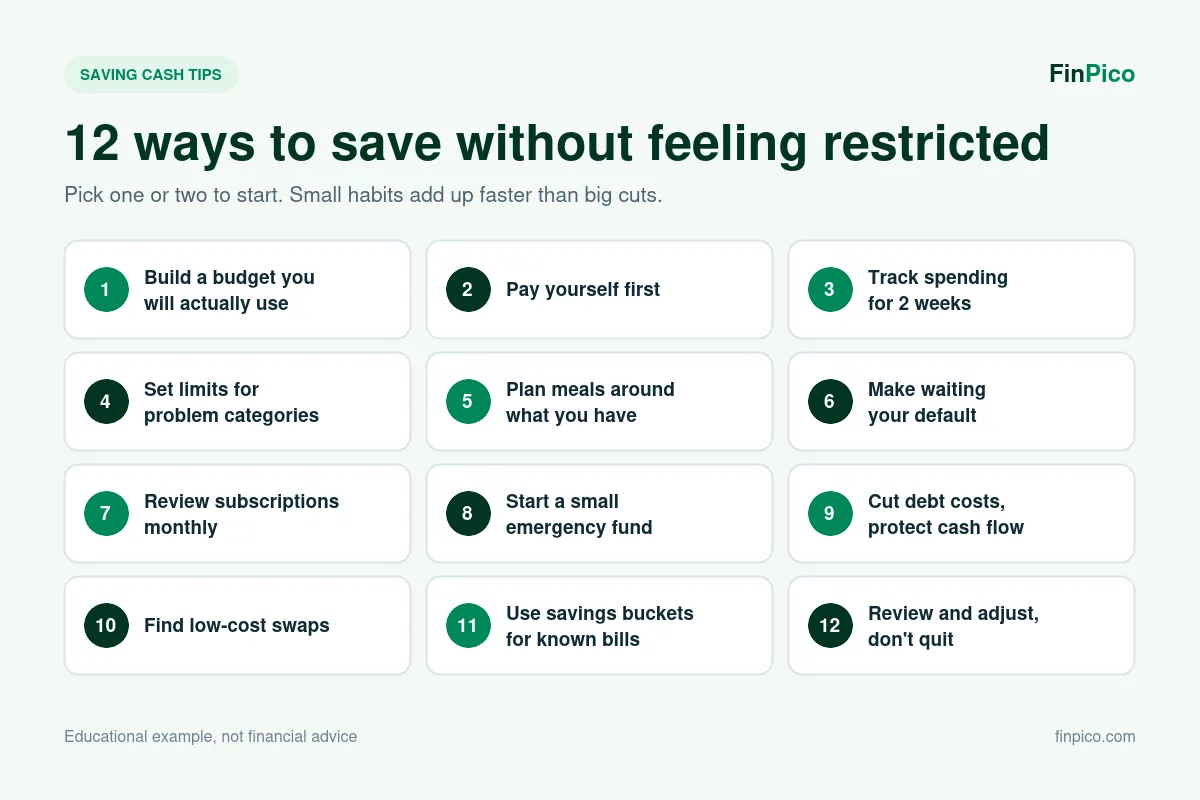
1. Build a simple budget you will actually use
A budget does not need to be complicated to work. The best budget is one you understand, update, and follow consistently. If detailed spreadsheets make you avoid your money, use a simpler method: income at the top, bills next, savings next, then spending money.
Good budget tips start with realism. If you normally spend a certain amount on groceries, do not slash it in half overnight and expect success. Instead, trim gradually and redirect the difference toward savings. A workable budget should show what you can spend, what you need to save, and where you may be drifting off course.
Try separating your categories into three groups:
- Needs: Housing, utilities, basic food, transportation, minimum debt payments.
- Priorities: Savings, emergency fund, extra debt payoff, important family expenses.
- Wants: Restaurants, shopping, subscriptions, upgrades, entertainment.
Use our monthly budget calculator to put actual income and expenses into a simple plan. This structure makes decisions clearer. You are not guessing whether you can afford something; you are checking whether it fits the plan.
2. Pay yourself first before money gets busy
A useful habit is to give savings a place in your plan before making optional purchases. If you wait until the end of the month, daily expenses will usually claim whatever is left. Paying yourself first means setting aside an affordable amount when income arrives, after accounting for essential bills and required payments.
The amount can be small at the beginning. Even a modest transfer builds the habit and creates a sense of progress. As your income grows or expenses drop, increase the transfer. The key is consistency, because repeated action matters more than one dramatic deposit.
If possible, automate an affordable transfer to a separate savings account. Check payment dates, minimum balance requirements and available funds first, so the transfer does not trigger an overdraft. With irregular income, a manual transfer after each payment may be easier to manage. Keeping savings away from your everyday checking account reduces the temptation to dip into it for non-urgent purchases. This helps because it removes the need to make the same decision over and over.
3. Track spending for two weeks before cutting costs
Many people try to save cash by guessing where their money goes. Tracking removes the guesswork. For two weeks, write down every purchase or review your transactions daily. Do not judge the spending at first; just capture it accurately.
Once you see the patterns, look for repeat purchases that do not add much value. A small convenience buy may be harmless once, but several times a week it can become a major drain. Tracking also reveals emotional spending, such as buying food, clothes, or digital extras when you are tired, stressed, or bored.
A simple spending review can include:
- Purchases you forgot about almost immediately.
- Subscriptions you rarely use.
- Groceries that spoil before you eat them.
- Fees caused by late payments or low balances.
- “Small” purchases that happen too often.
This makes the advice personal. Instead of following random rules, you make changes based on your actual habits.
4. Use cash or spending limits for problem categories
Some categories are harder to control than others. If dining out, coffee, online shopping, or weekend spending keeps breaking your budget, set a firm limit for that category. You can use physical cash, a separate debit account, or a weekly transfer to keep spending visible.
Cash works because it creates friction. When the envelope is empty, the category is finished until the next refill. Digital limits can work the same way if you check the balance before buying and avoid overdraft or credit card backup.
This strategy is not about shame. It is about making the boundary obvious. When money is mixed together in one account, it is easy to spend rent money, grocery money, and savings money without realizing it. Clear limits protect your priorities.
5. Plan meals around what you already have
Food is one of the most flexible areas for saving cash. You do not need to eat poorly or make every meal from scratch, but you do need a plan. Start by checking your pantry, fridge, and freezer before shopping. Then build meals around ingredients you already own.
Meal planning saves money in three ways. It reduces duplicate purchases, lowers food waste, and helps you avoid last-minute takeout. A basic plan can be as simple as choosing three dinners, two easy lunches, and a few breakfast options for the week.
Try these grocery-saving habits:
- Shop with a list and avoid browsing when hungry.
- Choose flexible ingredients that work in several meals.
- Cook extra portions for lunch or freezer meals.
- Compare unit prices instead of package prices.
- Keep quick backup meals available for busy nights.
The goal is not perfection. The goal is fewer expensive decisions made when you are rushed.
6. Make waiting your default buying rule
Impulse buying can undo a careful budget quickly. A waiting rule gives you time to decide whether a purchase is useful, affordable, and aligned with your goals. For small non-essential items, wait 24 hours. For larger purchases, wait several days or longer.
During the waiting period, ask yourself what problem the item solves. If you still want it and it fits your budget, buy it without guilt. If the urge fades, you just saved cash with almost no effort.
This is a useful saving habit because it protects you from marketing pressure. Sales, limited-time offers, and social media recommendations often create urgency. Waiting shifts control back to you.
7. Review subscriptions and recurring charges monthly
Recurring charges are easy to ignore because they happen automatically. Streaming services, apps, memberships, cloud storage, delivery programs, and trial renewals can quietly eat into your cash flow. A monthly review helps you catch costs before they become background noise.
Go through your bank and card statements line by line. Cancel anything you do not use, downgrade anything you use lightly, and avoid keeping services “just in case.” If you cancel something and truly miss it, you can usually restart later.
For stronger cash management, keep a list of every recurring charge with the amount and billing date. This prevents surprises and helps you plan around larger annual expenses. It also gives you an easy place to look when you need quick savings.
8. Create a small emergency fund before chasing big goals
An emergency fund is the buffer between you and expensive panic decisions. Without cash set aside, a car repair, medical bill, or urgent home expense can push you toward credit cards or loans. Even a small starter fund can reduce stress and protect your progress.
Our emergency fund calculator helps estimate a target from essential spending and your chosen coverage period. Begin with a realistic first target. The exact amount depends on your income, expenses, and responsibilities, but the purpose is the same: cash for true surprises. Keep this money separate from everyday spending so it does not disappear into normal purchases.
The CFPB’s emergency fund guide explains saving consistently and watching balances when using automatic transfers. Once your starter fund is in place, continue building over time. This supports the rest of your plan because it gives your budget room to survive real life. A savings plan that collapses at the first unexpected bill is not really secure.
9. Reduce debt costs while protecting cash flow
Debt payments can limit your ability to save, especially when interest charges are high. Review each debt, including the balance, minimum payment, and interest rate. Keep required minimum payments on every debt in your plan before directing extra money to a chosen balance. Then choose a payoff method that keeps you motivated and does not leave you short on essentials.
Two common approaches are useful. The avalanche method targets higher-interest debt first, which can reduce total interest costs over time. The snowball method targets smaller balances first, which can create quick wins and momentum. The right choice is the one you can follow consistently.
Avoid sending every spare dollar to debt if it leaves you with no cash cushion. A small emergency fund and a debt plan can work together. That balance keeps you from paying down a card, facing an emergency, and charging the card again.
10. Find low-cost swaps that do not feel like sacrifice
Low-cost swaps work best when they improve your life or at least keep it comfortable. Instead of cutting everything fun, look for swaps that reduce cost without removing enjoyment. You might choose a home coffee setup you like, free community events, library apps, shared meals with friends, or at-home movie nights.
The strongest swaps are repeatable. Saving once is helpful, but replacing a frequent expense creates ongoing room in your budget. If a swap feels miserable, it probably will not last. If it feels easy, it can become part of your routine with little effort.
Consider these practical swaps:
- Replace one restaurant meal per week with a planned easy dinner.
- Borrow books, tools, or media before buying.
- Choose generic or store-brand items when quality is similar.
- Repair, tailor, or repurpose items before replacing them.
- Use free exercise options before paying for unused memberships.
Small swaps are not small when they repeat for months.
11. Set up separate savings buckets for known expenses
Not every “unexpected” expense is truly unexpected. Holidays, school costs, insurance renewals, birthdays, car maintenance, and seasonal bills often arrive on a predictable schedule. Savings buckets help you prepare for them in advance.
You can use separate savings accounts, labeled categories in a budgeting app, or a simple spreadsheet. Divide the expected cost by the number of months until you need the money, then save that amount regularly. This turns large, stressful bills into manageable monthly amounts.
Savings buckets also make your cash more honest. If your account shows a healthy balance but much of that money is already assigned to future expenses, you are less likely to overspend. Clear labels protect your savings from becoming accidental spending money.
12. Review your progress and adjust without quitting
A savings plan should change as your life changes. Income, bills, family needs, and goals can shift, so review your budget at least once a month. Look at what worked, what felt unrealistic, and what needs a new limit.
Do not treat one difficult week as failure. Overspending happens, emergencies happen, and motivation rises and falls. The important move is to return to the plan quickly and adjust the system if the same problem keeps repeating.
Use a monthly money review to answer four questions:
- Did I save the amount I planned to save?
- Which category went over budget and why?
- What upcoming expense needs a savings bucket?
- What is one change I can make next month?
This keeps your plan practical instead of theoretical.
A small monthly savings example
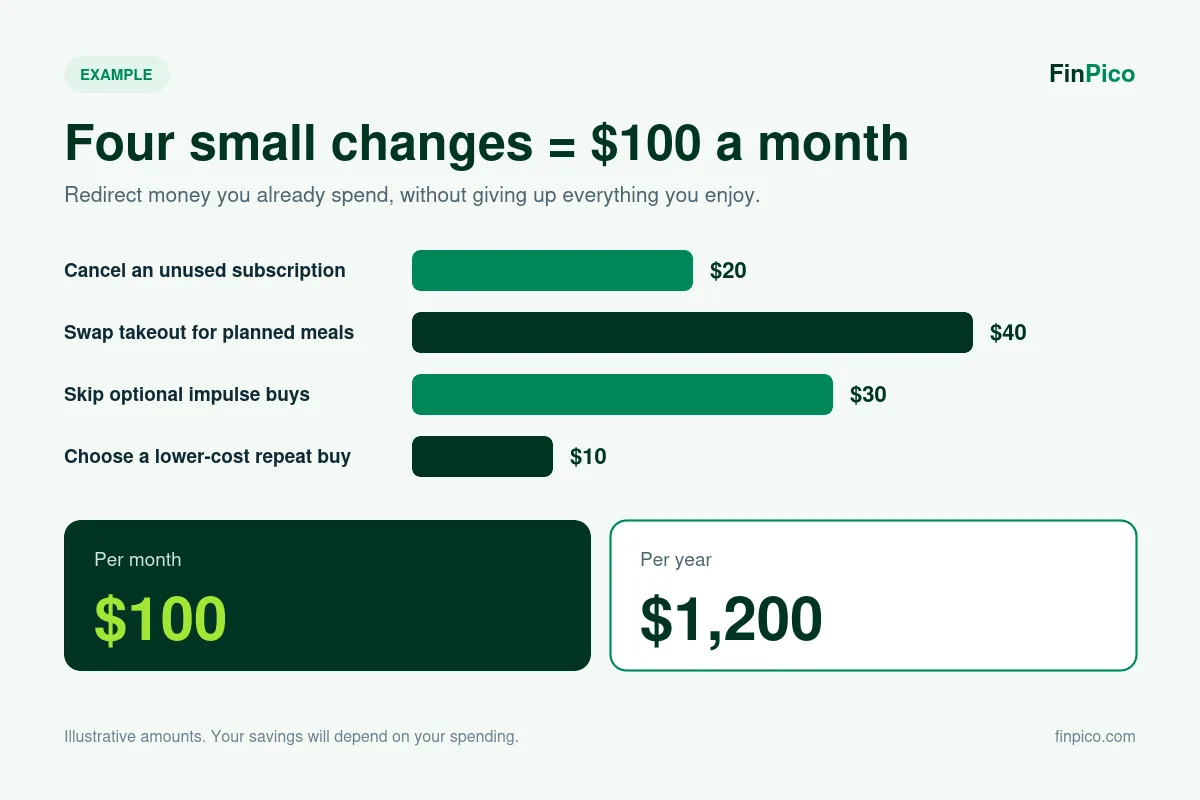
Suppose you identify the following changes in your own spending. These are illustrative amounts, not typical savings or a guaranteed result. Keep only changes that suit your circumstances.
| Change | Example monthly saving |
|---|---|
| Cancel an unused subscription | $20 |
| Replace some takeout with planned meals | $40 |
| Skip optional impulse purchases | $30 |
| Choose a lower-cost repeat purchase | $10 |
| Total available to redirect | $100 |
If you consistently transfer that $100 each month, contributions total $600 in six months or $1,200 in a year, before interest, fees or withdrawals. A purchase you avoid becomes savings only if that money remains available rather than being spent elsewhere.
Use the savings goal calculator to compare your own target and timeframe. If essentials already use your entire income, focus on support options and income opportunities rather than assuming small cuts will solve the gap. Our low-income budgeting guide can help organize those priorities.
Start with one strategy and build from there
You do not need to master every idea at once to make progress. Choose one or two saving cash tips that feel realistic this week, such as tracking spending, automating a small transfer, or planning meals before shopping. Once those habits feel normal, add another layer.
Smart money saving advice is practical, repeatable, and flexible. When you combine a simple budget, clear spending limits, emergency savings, and regular reviews, cash becomes easier to manage. Over time, those small decisions create more breathing room and more control over where your money goes.
Common questions about saving cash
How much should I save from each paycheck?
Choose an amount that leaves enough for essential bills and required payments until the next payday. Start small if necessary, review actual spending and increase it when there is room.
Should I keep all my savings as physical cash?
No single method fits everyone. Physical cash can help limit spending, but it can be lost or stolen. Compare suitable savings-account fees, access and deposit protection, and keep records of money assigned to different goals.
What if there is nothing left to cut?
A tight budget is not always a spending-habit problem. Review benefit eligibility, payment support and ways to improve income. Protect essentials rather than skipping necessary food, medicine or required payments to meet a savings target.
Sources and further reading
We use official U.S. government and nonprofit resources to check the guidance in this article. These are good places to go deeper:
- Consumer Financial Protection Bureau: Building an emergency fund — practical steps for starting and growing emergency savings.
- Federal Reserve: Survey of Household Economics and Decisionmaking — yearly data on how U.S. households handle emergency expenses, savings and income swings.
- FDIC Money Smart — free, unbiased lessons on budgeting, saving and managing everyday accounts.
- MyMoney.gov — the U.S. government’s financial education hub covering earning, saving, spending and borrowing.
Last reviewed by Rizwan Mughal on November 6, 2026.
Rizwan Mughal
Rizwan Mughal is the founder and editor of FinPico. He researches budgeting, saving and small-business costs using official sources such as the CFPB, the Bureau of Labor Statistics and the Federal Reserve, and builds the free FinPico calculators. Every guide is checked against our editorial policy and updated when the numbers change.