
FinPico explains general financial concepts and calculator assumptions. Verify current terms and rules with official sources before acting.

Illustration: FinPico
If you are learning how to budget money on low income, start with reliable take-home pay and the bills due before your next payday. A realistic plan protects essentials, accounts for irregular costs and shows a shortfall early.
When most of your paycheck already has a job, making a budget can feel like being asked to solve a puzzle with missing pieces. Rent still comes due. Groceries still cost money. And one unexpected bill can undo a careful plan.
A useful budget starts with the money you actually have and the costs you cannot avoid. It should help you spot a shortfall early, choose your next step and spend with a little more clarity. Here is a practical way to build one without pretending every problem can be fixed by cutting coffee.
Start with take-home income, protect essential expenses, give irregular bills a monthly place in your plan and check the numbers each payday. If essentials exceed income, focus on closing that gap before chasing a savings percentage.
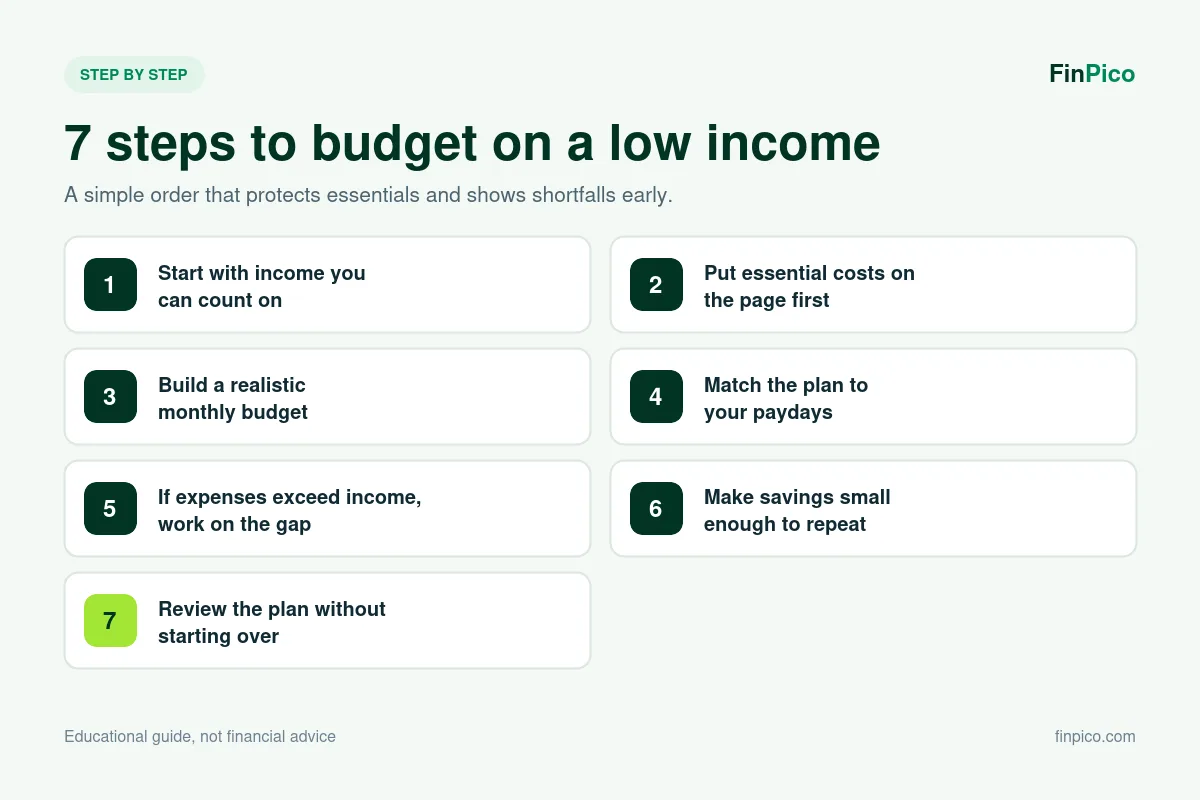
1. Start with income you can count on
- Start with take-home pay: the amount arriving in your account after deductions.
- Add reliable household income available for shared expenses.
- Leave uncertain income out for now: count overtime, gifts and side income when the money actually arrives.
If your pay changes, review several recent months and choose a cautious starting amount that reflects your current work. A strong month is not automatically your normal month. When extra income arrives, decide whether it needs to cover next month’s essentials, an overdue bill or a reserve.
For weekly or biweekly pay, also look at the actual pay dates. An average monthly figure can look comfortable while your account is short on the day rent is due.
2. Put essential costs on the page first
Use recent statements and receipts to list the costs your household needs to cover:
- Home: housing and basic utilities.
- Everyday essentials: groceries and necessary transportation.
- Health and work: essential health costs and childcare needed for work.
- Debt commitments: required minimum payments.
Then look for expenses that do not arrive every month: car registration, school supplies or an annual insurance bill. For a full year of saving, divide a known yearly cost by 12. A $240 bill would need $20 a month over 12 months. If it is due sooner, subtract what you have already saved and divide the remaining cost by the months left.
Needs and wants can overlap. Internet may be necessary for work, while a more expensive package may be optional. The goal is to understand your choices without judging every purchase.
3. Build a realistic monthly budget
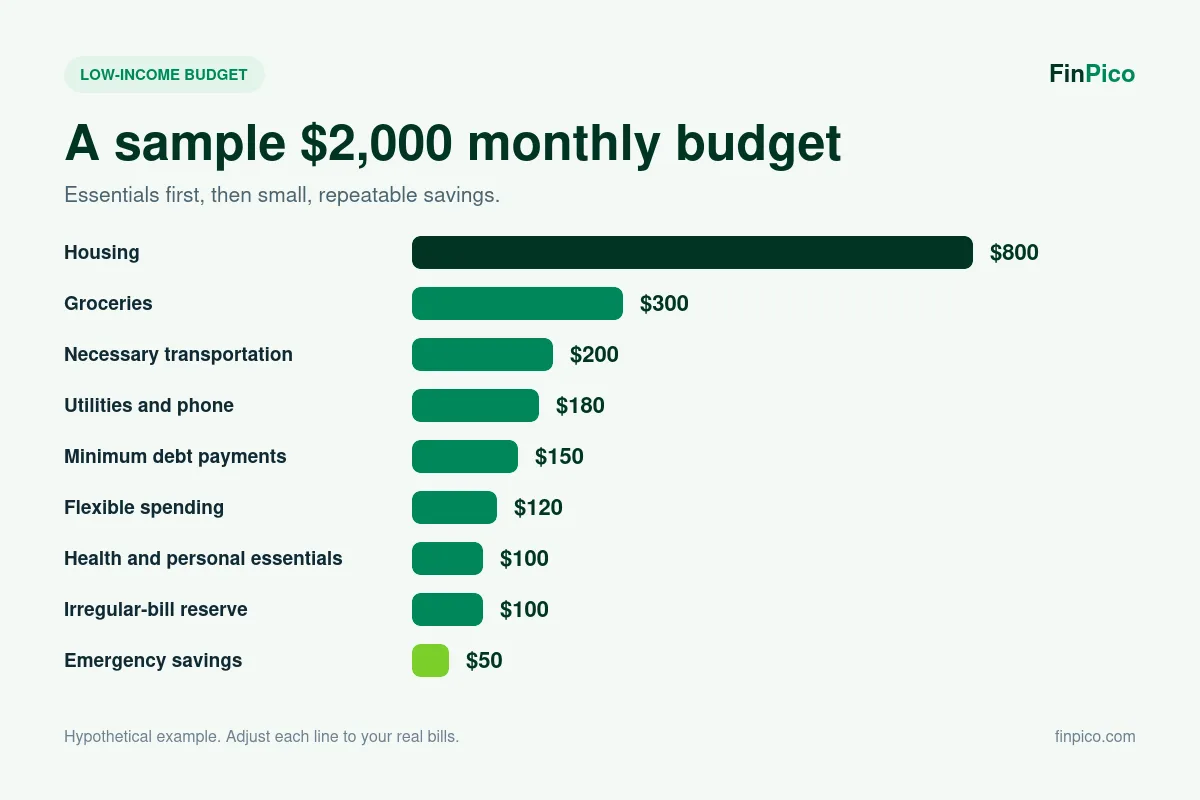
Here is an illustrative budget for someone taking home $2,000 a month. These are sample amounts, not suggested local prices or a claim that this income covers every household.
| Category | Monthly amount |
|---|---|
| Housing | $800 |
| Utilities and phone | $180 |
| Groceries | $300 |
| Necessary transportation | $200 |
| Health and personal essentials | $100 |
| Minimum debt payments | $150 |
| Irregular-bill reserve | $100 |
| Emergency savings | $50 |
| Flexible spending | $120 |
| Total planned | $2,000 |
This plan gives every dollar a purpose, including a small amount of flexibility. It does not leave $50 in emergency savings and then count that same $50 again as available spending. If your rent is higher or you have dependents, your version will look different.
Use our free Monthly Budget Calculator to compare take-home income with expenses. A negative result is useful information: it shows the gap your next decisions need to address.
Budgeting tips for low income families
A family budget needs to cover shared costs without counting the same income or purchase twice. Agree on which money is available for household bills and which payments each adult handles.
- Plan one shared grocery amount: include school lunches and basic household supplies, then track purchases against the same total.
- List childcare and school costs: include work-related childcare, transport, uniforms and known activity fees rather than treating them all as emergencies.
- Separate restricted resources: if assistance can only pay for an eligible category, do not count it as unrestricted cash for rent or debt.
- Review together each payday: confirm the next bills and agree on a realistic flexible-spending limit.
The $2,000 example above is an arithmetic illustration, not a family cost benchmark. Add dependents’ actual needs before deciding whether your own income covers the plan.
A small family expense example
| Known upcoming cost | Time remaining | Monthly amount to reserve |
|---|---|---|
| $120 school supplies | 4 months | $30 |
| $240 annual bill | 6 months | $40 |
| Total reserve for these two costs | $70 |
This $70 belongs inside your existing expense plan; it is not extra money. If only $40 is available, the $30 gap needs a concrete adjustment. When a due date is less than a year away, divide the remaining cost by the months left—not automatically by 12.
4. Match the plan to your paydays
A monthly budget answers “Can this month work?” A bill calendar answers “Will the money be there on Tuesday?” Write down your next pay dates and the due dates of essential bills.
- Reserve upcoming bills: set aside payments due before your next paycheck.
- Keep daily spending covered: allow enough for groceries and transport.
- Ask about due dates: a provider may offer a different payment date. Check the conditions first.
- Watch automatic payments: they can trigger fees when your account balance is too low.
5. If expenses exceed income, work on the gap
- Check the numbers: remove duplicate entries or an expense that has ended.
- Find small changes: an unused subscription may free up a little room.
- Plan larger changes carefully: housing and transportation decisions can involve tradeoffs and upfront costs.
If you cannot cover everything, consider the consequences of missing each payment. Protect housing, essential services and the costs that allow you to keep working. Contact lenders or service providers early to ask about hardship arrangements, fees and how any change affects your account. Do not assume assistance is guaranteed.
For a structured way to think through difficult choices, see the Consumer Financial Protection Bureau’s Your Money, Your Goals resources. Local assistance or additional income may be part of the solution when reasonable spending cuts are not enough.
6. Make savings small enough to repeat
If there is room, begin with an amount you can sustain—even $5 or $10 per payday. A first buffer can help with a small unexpected expense; it is not a substitute for a larger safety net.
Keep known upcoming bills separate from emergency savings. Use the Savings Goal Calculator for a specific purchase or bill, and the Emergency Fund Calculator to explore a longer-term reserve based on essential expenses.
7. Review the plan without starting over
Give your budget a ten-minute check each week:
- Confirm which payments have cleared.
- Look at bills coming up before your next payday.
- Adjust a category that is running short.
- Record where the extra money comes from.
If groceries run $30 over, move $30 from another available category. Avoid quietly borrowing from money already reserved for rent.
The 50/30/20 framework can help compare spending patterns, but it is not a pass-or-fail test. On a tight income, essentials may take more than half your pay. Start with a workable plan and improve it as circumstances allow.
Common questions
How do I budget money on low income when bills exceed my pay?
List the exact gap first. Check for duplicate costs, pause optional spending where practical and contact providers early about payment or hardship options. If essentials still exceed reliable income, investigate assistance and realistic income changes. Do not force a savings percentage into a plan that cannot cover necessities.
How can a low-income family manage irregular bills?
List the amount, due date and money already reserved. Divide the remaining cost by the paydays or months left, then include that amount in the shared budget. Revisit the plan when childcare, school or household needs change.
What if I have no money left to save?
Focus first on a workable essentials plan and the reason for the shortfall. Look into relevant assistance, payment options and income opportunities. A budget can reveal the problem, but cannot create money that is not there.
Should I save or pay off debt first?
There is no single answer for every household. Consider required payments, interest, arrears and the risk of needing to borrow again for an emergency. A small buffer alongside required payments may be useful; complex debt problems may warrant qualified guidance.
Do I need a paid budgeting app?
No. A notebook, spreadsheet or free calculator can work. Choose something you will update regularly, and be careful about sharing bank credentials with unfamiliar services.
Your next step: Write down your next paycheck, the bills due before the following one and your available grocery and transport money. That is enough to start. Build the wider monthly plan from there.
This guide provides general education, not personalized financial, tax or legal advice. Examples are hypothetical. Read our financial disclaimer and correction policy.
Sources and further reading
We use official U.S. government and nonprofit resources to check the guidance in this article. These are good places to go deeper:
- Consumer Financial Protection Bureau: Your Money, Your Goals — worksheets for budgeting, tracking spending and planning for bills.
- USAGov: Government benefits — find federal and state programs for food, housing, utilities and health costs.
- 211 (United Way) — free, confidential help finding local assistance with rent, utilities, food and other essentials.
- Federal Reserve: Survey of Household Economics and Decisionmaking — yearly data on how U.S. households handle emergency expenses, savings and income swings.
Last reviewed by Rizwan Mughal on November 6, 2026.
Rizwan Mughal
Rizwan Mughal is the founder and editor of FinPico. He researches budgeting, saving and small-business costs using official sources such as the CFPB, the Bureau of Labor Statistics and the Federal Reserve, and builds the free FinPico calculators. Every guide is checked against our editorial policy and updated when the numbers change.