
FinPico explains general financial concepts and calculator assumptions. Verify current terms and rules with official sources before acting.
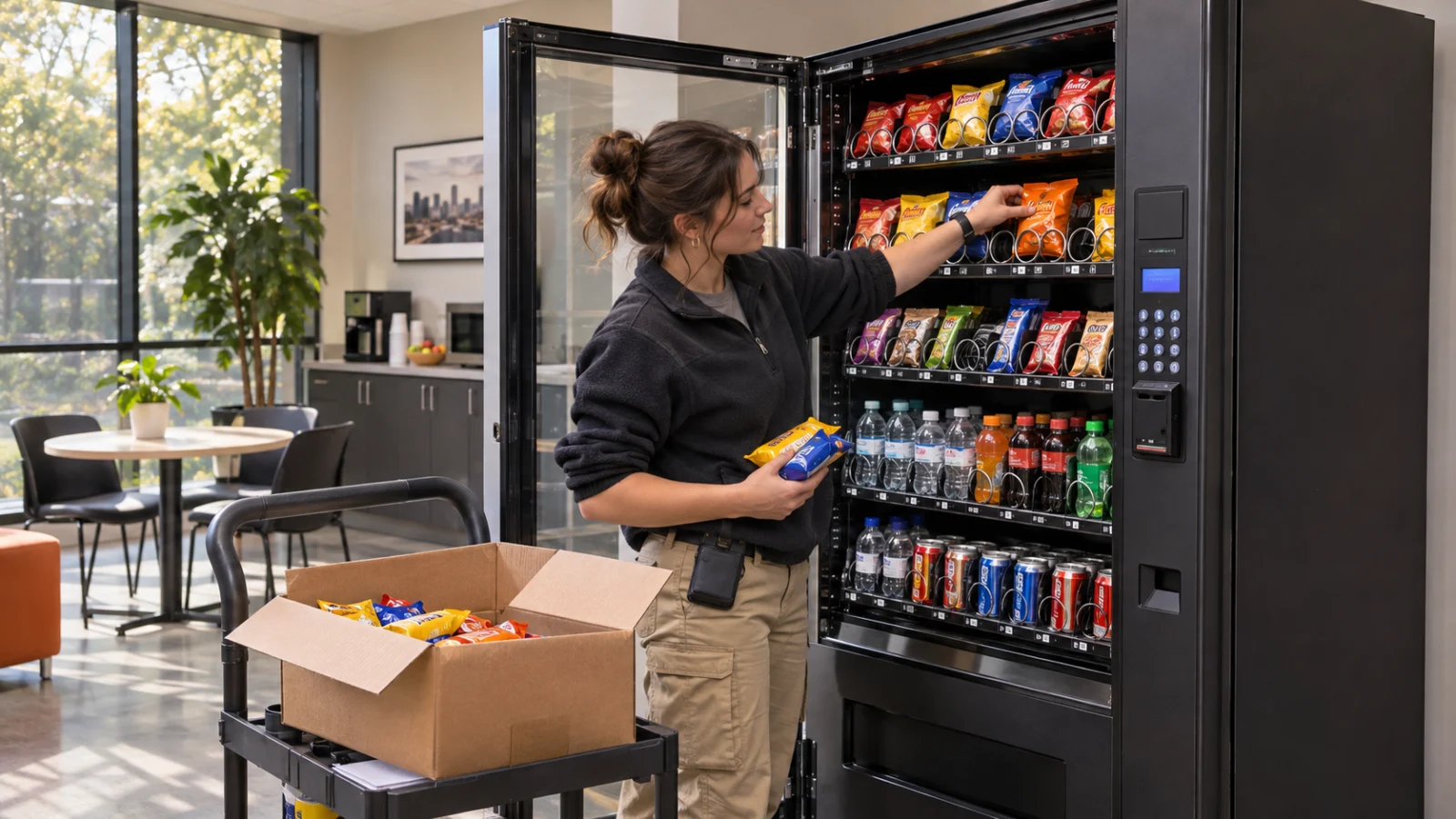
Illustration: FinPico
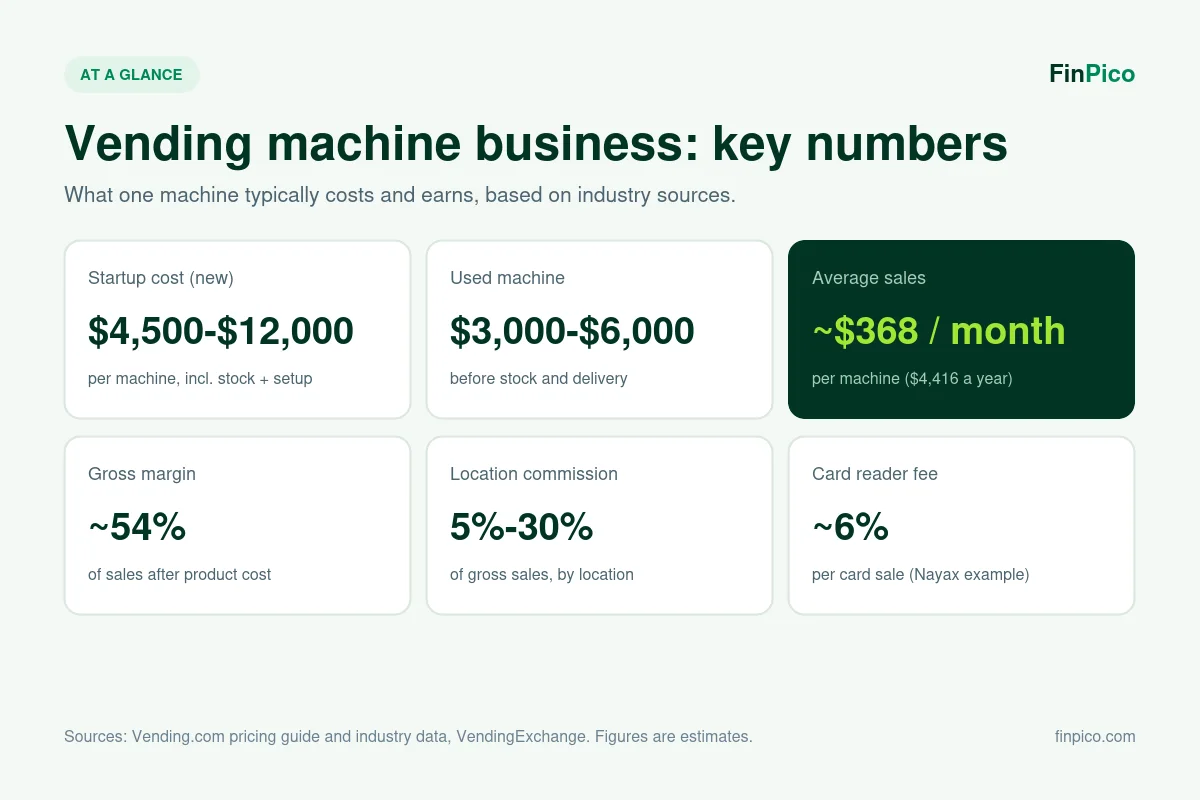
A vending machine business is one of the simplest small businesses you can start: you buy a machine, place it in a busy spot, keep it stocked and collect the sales. One new machine typically costs $4,500 to $12,000 to launch, and an average machine sells about $4,416 a year. That makes it a good side income, not a get-rich-quick plan. This guide shows the real costs, the profit math for one machine and the eight steps to start.
Key takeaways
- Location decides everything. The same machine can make about $80 or $360 a month depending on foot traffic.
- Find the location before you buy the machine. A machine sitting in your garage earns nothing.
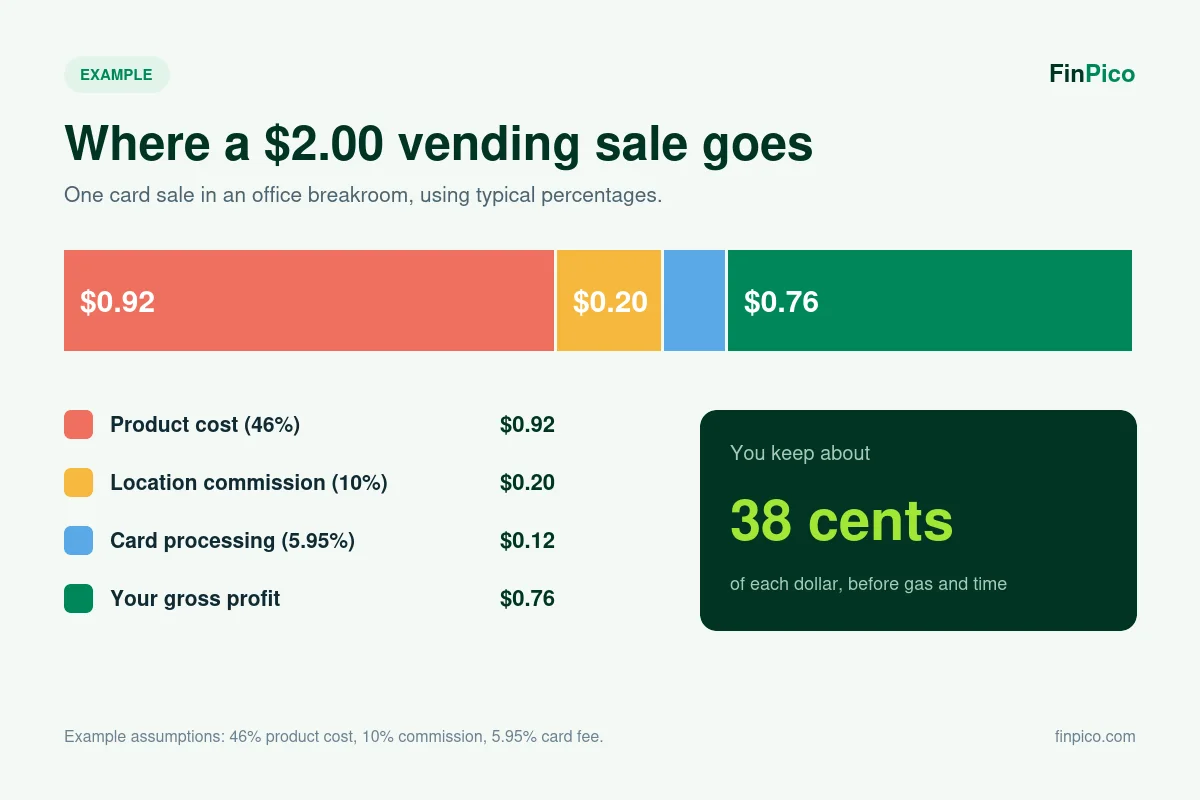
- Expect to keep roughly 38 cents of each dollar after product cost, commission and card fees, before gas and your time.
- Used machines pay back faster. In our average example, a new setup pays back in about 43 months and a used one in about 23.
- Avoid “turnkey” offers that promise high income and guaranteed locations. The FTC has sued sellers that made those claims.
How a vending machine business works
You own the machine and the products inside it. A business (the “location”) lets you place the machine on its property, usually in exchange for a share of sales called a commission. Customers pay by card or cash, and you visit the machine to restock it, collect cash and fix problems.
Your money comes from the gap between what you pay for a product and what you sell it for. If you buy a soda for $0.92 and sell it for $2.00, the $1.08 difference has to cover the location’s commission, card fees, gas and your time. Whatever is left is your profit.
The industry is large and still growing. The National Automatic Merchandising Association (NAMA) put U.S. convenience services revenue, which includes vending, at an expected $31.1 billion for 2025, up from $26.6 billion in 2023, according to Vending Market Watch.
Is a vending machine business a good business?
It can be, if you treat it like a small route business and not passive income. Here is the honest trade-off.
Pros
- Low skill barrier. No special license or degree in most places.
- Flexible hours. You can restock evenings or weekends.
- Starts small. One machine is a real test of the business.
- Scales by adding machines and building a route.
- Card readers make it easier to sell at $2 to $3 per item.
Cons
- Not truly passive. Machines need restocking, cleaning and repairs.
- Good locations are competitive and take effort to win.
- Profit per machine is modest, so you need several to matter.
- Theft, vandalism and expired stock eat into profit.
- Card fees take about 6% of each card sale.
Best for: people who want a hands-on side business, live near offices, gyms or apartment buildings, and can reach $3,000 to $8,000 to start. Not for: anyone who needs income in the next month or expects money without work.
How much does it cost to start a vending machine business?
Most of your startup money goes into the machine itself. A 2026 pricing guide from Vending.com lists these new-machine price ranges:
| Machine type | New price range | Good for |
|---|---|---|
| Snack machine | $3,850–$7,800 | Offices, schools, waiting rooms |
| Cold drink machine | $5,700–$8,300 | Gyms, warehouses, outdoor areas |
| Combo (snack + drink) | $5,350–$8,600 | Small locations that need both |
| Fresh food | $6,100–$9,100 | Hospitals, large workplaces |
| Smart cooler / micro market | $3,500–$13,150 | Offices with trusted staff |
| Used machine (any type) | $3,000–$6,000+ | Testing the business on a budget |
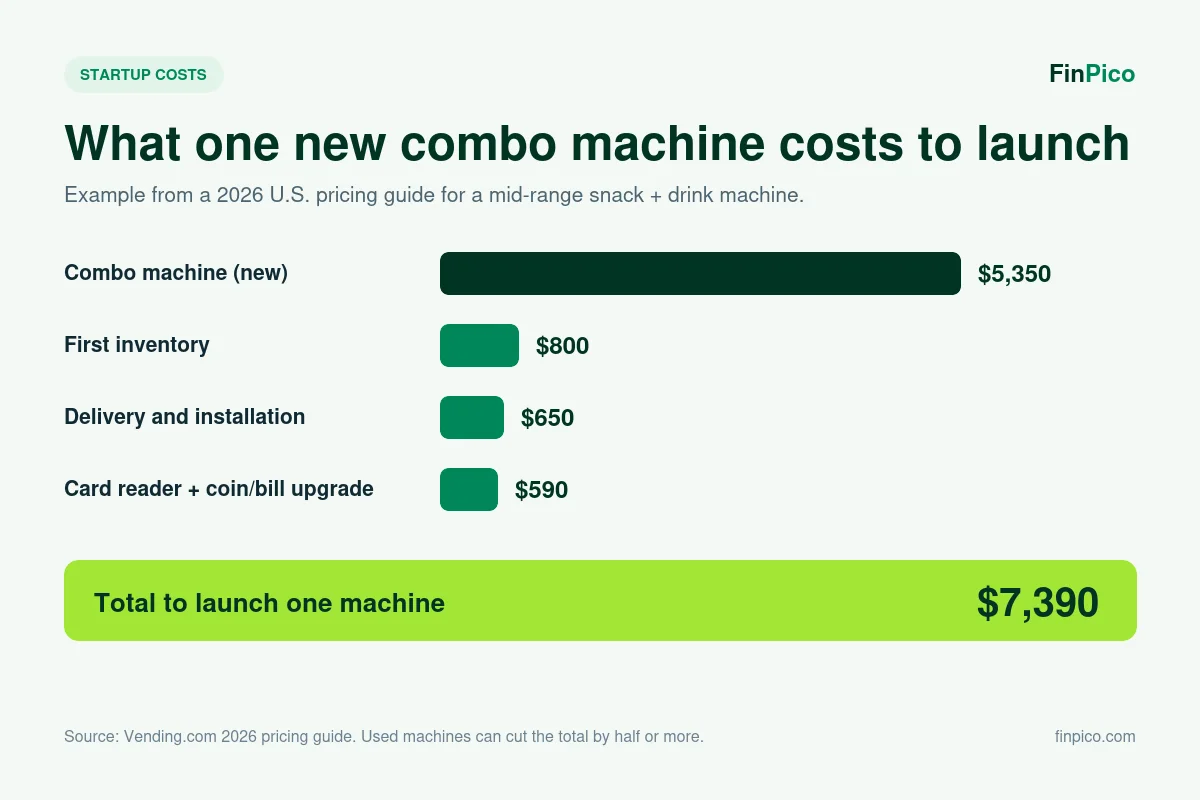
On top of the machine, budget for your first stock ($300–$1,500), delivery and installation ($300–$1,000), a card reader and payment upgrades (around $590 in the guide’s example) and business setup such as an LLC and permits ($200–$1,000). The same guide puts the all-in total at $4,500 to $12,000 per machine.
Tip: If you are saving up for your first machine, our savings goal calculator shows how much to set aside each month to reach $4,000 or $7,500 by a target date.
Your starter shopping list
Here is everything you need to buy for one machine, with typical costs. Starting lean with a used machine usually lands around $4,500.
| Item | Typical cost | Notes |
|---|---|---|
| Used or refurbished machine | $3,000–$6,000 | Cheapest way to test the business |
| New machine (instead of used) | $3,850–$8,600 | Warranty and fewer repairs |
| Card reader | About $300 + ~6% per card sale | Make sure it fits your machine |
| First stock | $300–$1,500 | About two weeks of best sellers |
| Delivery and installation | $300–$1,000 | Machines are heavy; use professionals if unsure |
| LLC, permits, sales tax permit | $200–$1,000 | Varies by state and city |
| General liability insurance | About $300–$600 a year | Median $442 a year through Insureon |
| Small extras | Low | Spare keys, price labels, cleaning kit, storage bins, a sales log |
Insurance figures: Insureon and VendingExchange. Other costs: Vending.com and CandyMachines.com.
How much do vending machines make?
An average vending machine sells about $4,416 a year (around $368 a month), and operators keep 54 cents or more of every sales dollar as gross profit after product cost, according to Vending.com. Your actual result depends mostly on how many people walk past the machine every day. For a full breakdown by location and machine type, see how much vending machines make per day, month and year.
To make this concrete, we ran the numbers for one combo machine in three locations. Everything stays the same except the number of sales per week:
- Average price: $2.00 per item
- Product cost: 46% of the price (matching the 54% gross margin above)
- Location commission: 10% of sales (office breakrooms often pay 5%–15%, per VendingExchange)
- Card processing: 5.95% of sales (the rate one major reader, Nayax, charges per card sale, per CandyMachines.com)
- Gas for restock trips: $20 to $35 a month
- Machine cost: $7,390 new (all-in) or about $4,000 used (all-in)
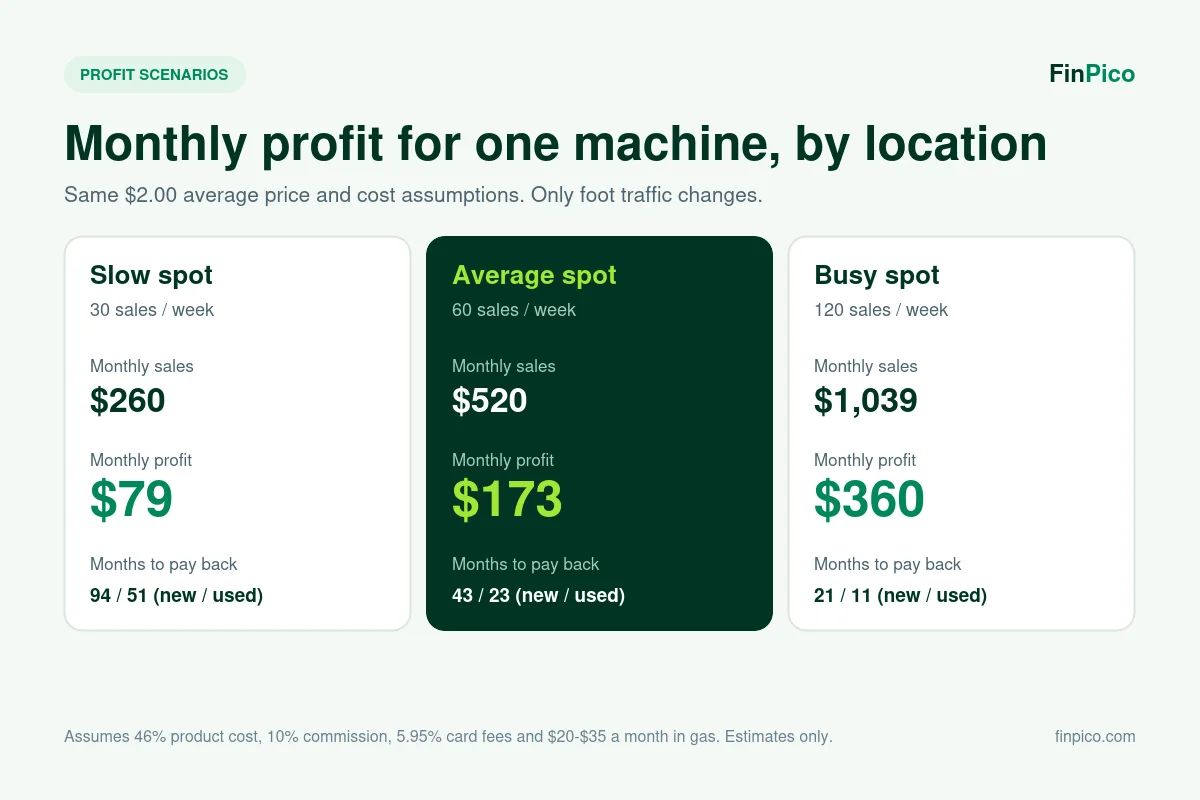
| Location | Sales per week | Monthly sales | Monthly profit | Payback (new / used) |
|---|---|---|---|---|
| Slow spot (small office) | 30 | $260 | $79 | 94 / 51 months |
| Average spot | 60 | $520 | $173 | 43 / 23 months |
| Busy spot (gym, warehouse) | 120 | $1,039 | $360 | 21 / 11 months |
Notice two things. First, a slow location barely pays for a new machine in eight years, so a weak spot is worse than no spot. Second, buying used cuts the payback time almost in half. That is why many operators start with one refurbished machine, prove the location, and only then buy new.
How many machines do you need to make $1,000 a month?
At the average-location profit of about $173 per machine, you would need roughly 6 machines to clear $1,000 a month, or about 3 machines in busy locations. To replace a full-time income, most operators need dozens of machines and a planned restocking route.
Vending machine profit calculator
Change the numbers to match your location. Results are estimates, not guarantees.
How to start a vending machine business in 8 steps
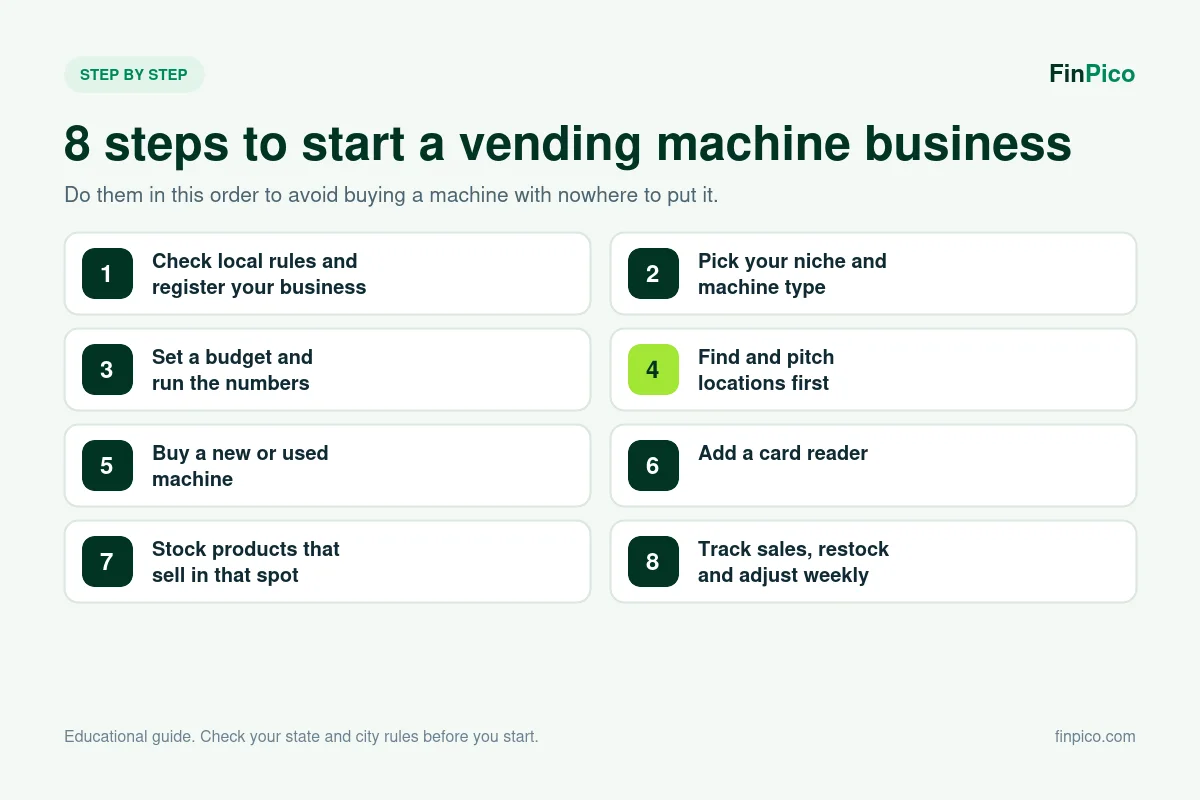
1. Check local rules and register your business
Rules depend on your state and city. Start with the SBA’s guide to licenses and permits. Many operators form an LLC to separate business and personal assets, get a free EIN from the IRS and open a separate bank account.
Two rules beginners often miss:
- Sales tax. Most states tax vending sales, and some have special rules. Colorado, for example, lets operators include sales tax in the price but requires a decal on every machine, and unregistered machines can be seized (Colorado Department of Revenue). Check your own state’s revenue department.
- Calorie labels. Operators with 20 or more machines must show calorie information for food they sell, under FDA vending machine labeling rules.
2. Pick your niche and machine type
Match the machine to the people who will use it. Office workers buy snacks and coffee drinks. Gym members buy water, sports drinks and protein bars. Warehouse and factory crews buy cold drinks and filling snacks, often on night shifts when nothing else is open. Start with one machine type you understand. Specialty machines can earn more per sale; see our guide to the cotton candy vending machine business.
3. Set a budget and run the numbers
Decide whether you will buy new, used or finance. Some sellers offer financing, which turns a $7,000 upfront cost into monthly payments of roughly $150 to $300, depending on terms (Vending.com). Use the calculator above: if a location cannot cover your payment with room to spare, skip it. Keep your personal emergency fund separate from business money.
4. Find and pitch locations first
This is the step that makes or breaks the business. Look for places with at least 50 people on site every day and no easy food option nearby: offices, auto shops, gyms, apartment laundry rooms, warehouses, car washes, hotels and break rooms at small factories. Walk in, ask for the owner or office manager and keep it short.
“Hi, I run a local vending service. I’d like to place a modern snack and drink machine here at no cost to you. I handle stocking, cleaning and repairs, it takes cards and phone payments, and I can share a percentage of sales with your business. Would you be open to a free trial for 60 days?”
Put the deal in writing. A simple agreement should cover the commission or rent, who pays for electricity, who is liable for damage, and how either side can end the deal.
Sample placement agreement (fill in the blanks)
This agreement is between [Your Business Name] (“Operator”) and [Location Business Name] (“Location”), starting on [Date].
1. Placement. Operator will place [number and type of machines] at [address and exact spot] at no cost to Location.
2. Service. Operator will stock, clean and repair the machines at its own cost and respond to service requests within [48 hours].
3. Commission. Operator will pay Location [0% / __% of gross sales / $__ per month], paid [monthly] with a sales summary.
4. Electricity and access. Location provides a standard outlet and access during [hours].
5. Ownership and liability. The machines and products belong to Operator. Operator carries general liability insurance.
6. Term. This agreement lasts [12 months] and renews automatically. Either side can end it with [30 days] written notice.
Signed: ________________ (Operator) ________________ (Location)
This is a simple starting point, not legal advice. Have a local business lawyer review your agreement before you sign.
5. Buy a new or used machine
Used machines cost less and pay back faster, but check that the coin mechanism, bill validator and cooling work, and that the machine can accept a card reader. New machines cost more but come with warranties and fewer repair surprises. Measure the doorway and the space before you buy.
6. Add a card reader
Many customers no longer carry cash, so a card reader is close to essential. Readers typically cost around $300, and processors charge a fee per card sale, about 5.95% for Nayax. Price your items so that fee is covered.
7. Stock products that sell in that spot
Buy stock from warehouse clubs or wholesale distributors, not regular stores. Start with proven sellers such as chips, candy bars, cookies, bottled water and sodas, then add a few healthier options. Check sales after two weeks and replace slow items. Watch expiration dates closely.
Not sure what to put in the machine? See our starter product mix with prices, wholesale costs and profit per item.
8. Track sales, restock and adjust weekly
Most card readers come with an app that shows what sold and when. Expect to visit each machine about once a week at first, then adjust your schedule to the sales data. Track every cost in a simple spreadsheet so you know your real profit per machine. Our monthly budget calculator is a quick way to see how this income fits your household budget.
Where to buy vending machines and stock
| Where to buy | Good for | Watch out for |
|---|---|---|
| Vending dealers and retailers (new) | Warranty, financing, support | Highest price |
| Refurbished machine sellers | Lower price, tested machines | Short or no warranty; ask in writing |
| Local operators selling machines or routes | Cheapest, sometimes with locations | Verify the location and its real sales |
| Facebook Marketplace, Craigslist, eBay | Bargains on older machines | Scams, no warranty, moving costs |
Where to buy stock: start with warehouse clubs such as Sam’s Club or Costco. As you grow, vending distributors such as Vistar (part of Performance Food Group) sell products packed for vending operators.
Used machine checklist
- Plug it in and test every row, spiral and button.
- Check that the coin mechanism and bill validator accept money and give change.
- For drink machines, confirm it cools to a safe temperature and holds it.
- Ask if it is MDB-compatible, so a card reader can be added.
- Make sure all keys and locks are included.
- Look for cracked glass, rust and water damage.
- Check that parts are still available for the model.
- Measure doors and hallways at your location, and confirm the outlet.
- Ask for a warranty or at least a short return window.
Source for key buying factors: Vending.com.
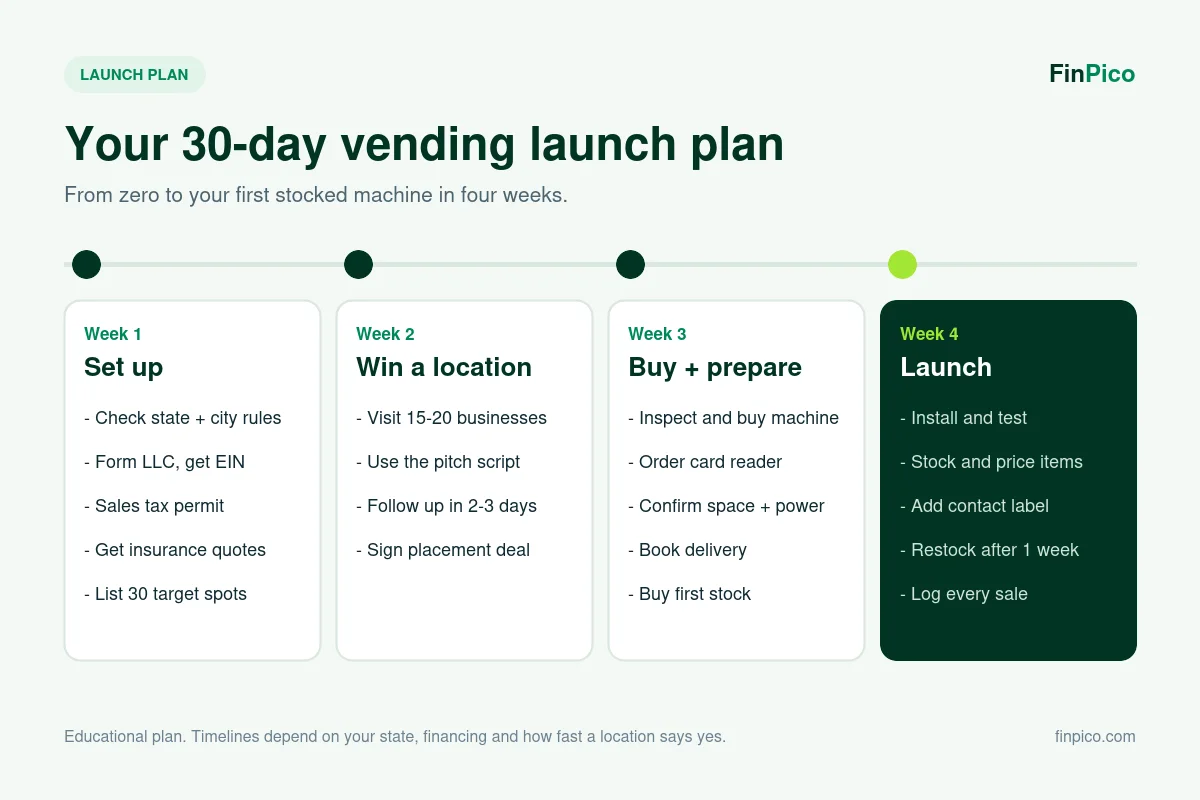
Your 30-day launch plan
Follow this order so you never pay for a machine before you have somewhere to put it.
| Week | Goal | To-do |
|---|---|---|
| Week 1 | Set up | Check rules, form an LLC, get an EIN and sales tax permit, get insurance quotes, list 30 target locations |
| Week 2 | Win a location | Visit 15–20 businesses, use the pitch script, follow up in 2–3 days, sign a placement agreement |
| Week 3 | Buy and prepare | Inspect and buy the machine, order a card reader, confirm space and power, book delivery, buy first stock |
| Week 4 | Launch | Install and test, stock and price items, add your contact label, restock after one week, log every sale |
Best vending machine locations
| Location | Why it works | Typical commission |
|---|---|---|
| Office breakrooms | Same people daily, steady snack demand | 0%–15% |
| Warehouses and factories | Long shifts, few food options nearby | 0%–15% |
| Gyms | Strong demand for water and protein snacks | 10%–20% |
| Schools | High volume, but strict product rules | 15%–30% |
| Malls and transit hubs | Very high traffic, very competitive | 20%–30% |
Commission ranges are from VendingExchange. Some smaller locations accept a flat monthly fee ($50–$100 per machine) or no fee at all because the machine is a perk for their staff.
Common mistakes and scams to avoid
- Buying before you have a location. Secure a signed spot first.
- “Turnkey” packages with income promises. The FTC sued one seller that claimed an eight-machine, $3,300 package could gross $81,000 a year; the agency said few buyers got their money back and the promised locations were not high-traffic (FTC). Be wary of anyone who guarantees earnings or locations.
- Ignoring card fees and commission. Together they can take 15% or more of every sale.
- Stocking what you like, not what sells. Let the sales data decide.
- Skipping insurance. Ask an insurance agent about general liability and equipment coverage.
Vending machine business FAQ
Is a vending machine business profitable?
It can be. In our example, one machine makes about $79 to $360 a month after product costs, commission, card fees and gas, depending on the location. Profit grows by adding machines in strong locations.
How much does it cost to start a vending machine business?
Plan on $4,500 to $12,000 per new machine including stock, delivery, a card reader and basic setup. A used machine can bring your all-in cost closer to $4,000.
How much does one vending machine make a month?
An average machine sells about $368 a month ($4,416 a year). After costs, profit in a typical location is often around $150 to $200 a month, and less in slow spots.
Do I need a license to own a vending machine?
Usually you need a general business license and a sales tax permit, and some states require a decal or registration for each machine. Requirements vary by state and city, so check with your local government and state revenue department.
Is a vending machine business passive income?
Not fully. You need to restock, clean, collect cash and handle repairs. It is flexible, part-time work, which is why many people run it as a side business.
How do I find a location for a vending machine?
Visit businesses with at least 50 people on site daily and few food options nearby, ask for the manager and offer free placement with a share of sales. Put the agreement in writing.
The bottom line
A vending machine business is a real, simple way to build side income, but the money comes from good locations and steady restocking, not from the machine itself. Start with one machine, ideally used, in a location you have already secured. Track your numbers for three months. If the machine pays its way, add a second one and start building a route.
Sources and further reading
- Vending.com: 2026 Vending Machine Pricing Guide — new and used machine prices, startup costs and financing.
- Vending.com: Make Money With Vending Machines — average annual sales per machine and gross profit.
- VendingExchange: Location Commission Explained — commission ranges by location type.
- Vending Market Watch: NAMA industry census — U.S. convenience services revenue.
- CandyMachines.com: Pros and cons of Nayax — card reader cost and transaction fee.
- U.S. Small Business Administration: Licenses and permits
- IRS: Get an Employer Identification Number
- Colorado Department of Revenue: Vending machines — example of state sales tax rules.
- FDA: Vending machine labeling requirements
- FTC: Crackdown on bogus business opportunities
Last reviewed by Rizwan Mughal on November 6, 2026. Figures are estimates based on the sources above and will vary by location.
Rizwan Mughal
Rizwan Mughal is the founder and editor of FinPico. He researches budgeting, saving and small-business costs using official sources such as the CFPB, the Bureau of Labor Statistics and the Federal Reserve, and builds the free FinPico calculators. Every guide is checked against our editorial policy and updated when the numbers change.