FinPico explains general financial concepts and calculator assumptions. Verify current terms and rules with official sources before acting.
Illustration: FinPico
You want a budget that helps you make decisions, not another task you abandon after payday. Two popular approaches can help: the 50/30/20 method gives you broad spending targets, while zero-based budgeting gives every dollar a specific job.
Neither method creates extra income or fits every household perfectly. The better choice depends on how much detail you need, how predictable your pay is and what you will realistically keep using. Let’s compare both with the same $3,000 monthly take-home income.
- Choose 50/30/20 if you want a simple overview and flexible spending categories.
- Try zero-based budgeting if you want to decide exactly where your available money goes.
- Combine them if broad targets help you plan but specific bill amounts help you follow through.
How the 50/30/20 budget works
The 50/30/20 framework divides take-home income into three broad groups:
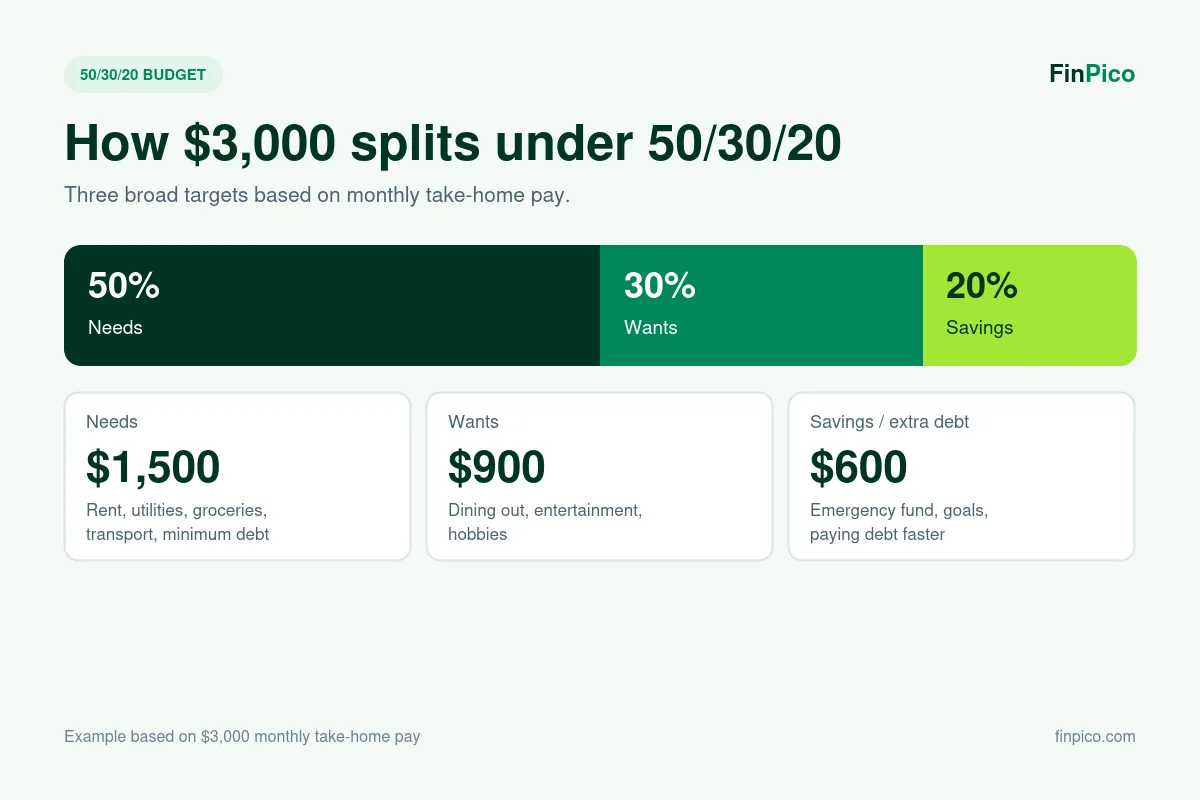
- 50% for needs: essential housing, basic groceries, utilities, necessary transportation and required minimum debt payments.
- 30% for wants: flexible purchases such as entertainment, optional subscriptions and dining out.
- 20% for savings and extra debt payments: money for future goals, a reserve or repayment above required minimums.
On $3,000 a month, those targets are $1,500, $900 and $600. They are a starting framework, not instructions to spend the full wants amount or skip essentials to meet a percentage. Classification also depends on your circumstances: internet needed for work has a different role from an optional service upgrade.
The CFPB’s Your Money, Your Goals resources offer tools for understanding income, spending and financial priorities. Use reliable information alongside your own bills.
How zero-based budgeting works
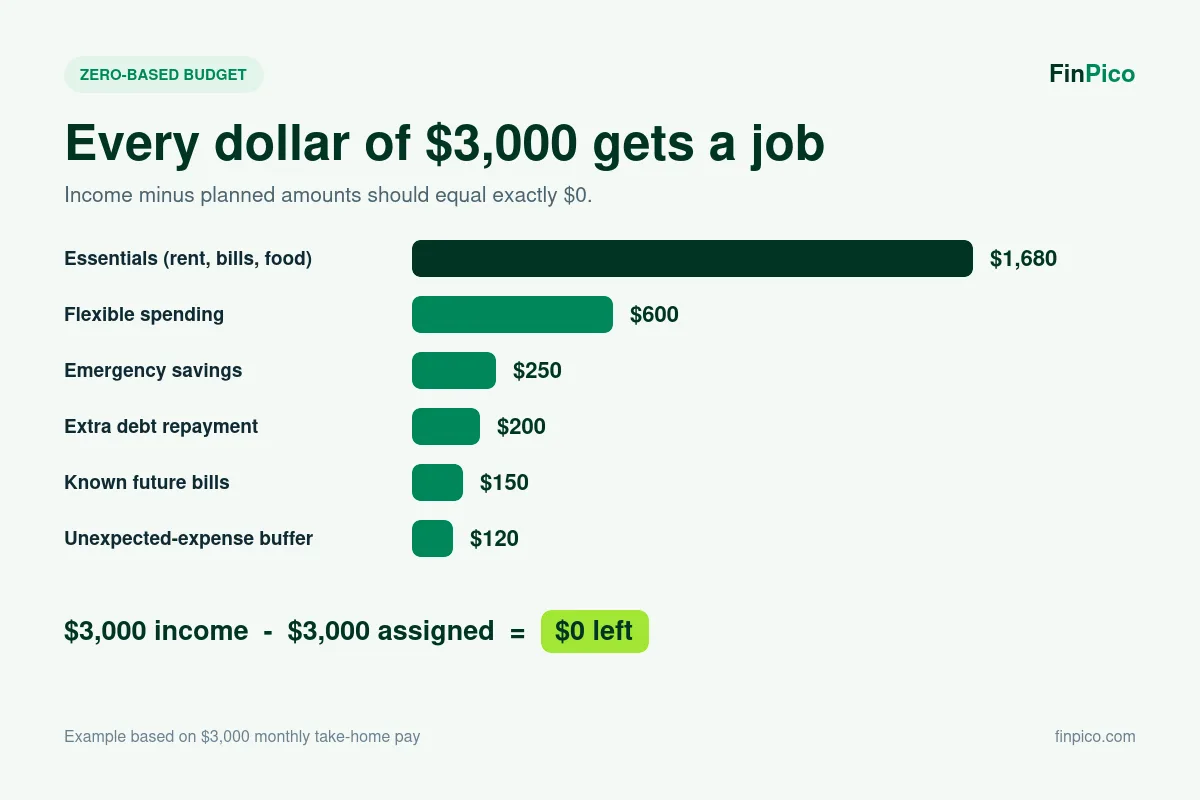
With a zero-based budget, you assign all available income to expenses, savings, debt payments or a buffer until the amount left unassigned is zero.
Zero unassigned does not mean zero in your bank account. Money allocated to next month’s rent or an emergency reserve stays saved until it is needed. It simply has a stated purpose.
- Write down the income available for the planning period.
- Allocate essential bills and everyday costs.
- Include known irregular expenses, savings and some realistic flexibility.
- Adjust the plan until allocations match available income.
If you overspend one category, identify another available category to reduce. Avoid using money already committed to an essential bill without accounting for the consequences.
The main differences at a glance
| Question | 50/30/20 | Zero-based |
|---|---|---|
| How is money assigned? | Three broad percentage targets | Specific amounts for every purpose |
| How much detail? | Usually fewer categories | Usually more categories and checks |
| Main strength | Simple overview of spending priorities | Clear allocations for bills and goals |
| Main limitation | Percentages may not fit essential costs | Requires more regular adjustments |
Neither approach removes the need to watch payment dates. A monthly plan can balance while the account is short before payday. Keep a bill calendar alongside whichever method you choose.
Same $3,000 income, two useful views
50/30/20 framework
Start with three percentage targets.
- Needs 50%$1,500
- Wants 30%$900
- Savings + extra debt 20%$600
Zero-based example
Give every available dollar a job.
- Essentials$1,680
- Flexible spending$600
- Unexpected-expense buffer$120
- Emergency savings$250
- Known future bills$150
- Extra debt repayment$200
Key difference: the first view gives broad targets; the second assigns actual amounts. Zero unassigned dollars does not mean zero money saved. These are examples, not recommended allocations for every household.
Imagine a household takes home $3,000 monthly and has $1,680 of essential costs. This fictional example demonstrates the methods; the amounts are not local price estimates or recommendations for every household.
| 50/30/20 target | Amount |
|---|---|
| Needs: 50% | $1,500 |
| Wants: 30% | $900 |
| Savings / extra debt: 20% | $600 |
The needs target is $180 below actual essentials. That is a signal to adjust the plan, not pretend the bill is smaller. Keeping $600 for savings and extra debt would leave $720 for flexible spending: a 56/24/20 allocation.
A zero-based version makes those assignments more specific:
| Assigned purpose | Amount |
|---|---|
| Rent, utilities, groceries, necessary travel and minimum debt payments | $1,680 |
| Dining, entertainment and other flexible spending | $600 |
| Unexpected-expense buffer, reserved within the plan | $120 |
| Emergency savings | $250 |
| Known future bills | $150 |
| Extra debt repayment | $200 |
| Total allocated | $3,000 |
The buffer is already assigned to unexpected small costs. It is not additional income. When used, record the expense so you know what remains. Both approaches can describe the same money; one emphasizes proportions, the other the jobs.
Explore broad targets with our 50/30/20 Budget Calculator, then check detailed income and expenses in the Monthly Budget Calculator.
Which approach fits your situation?
Start with 50/30/20 when…
- You want a quick overview before adding detail.
- Your essential expenses leave room for flexible spending and goals.
- You find a long category list difficult to maintain.
Try zero-based budgeting when…
- You regularly wonder where the remaining paycheck went.
- You need to set aside specific amounts for several bills or goals.
- You are willing to review and move allocations as circumstances change.
For a tight income, begin with actual essential costs under either system. If expenses exceed income, changing the budgeting label will not close the gap. Our low-income budgeting guide explains how to build an essentials-first plan.
What if your income changes each month?
Build the next plan around money you can reasonably rely on, and update it when income arrives. A strong month is not automatically your normal month.
- Prioritize the bills due before your next expected payment.
- Set aside money for known irregular costs.
- Decide where additional income goes before spending it.
- Keep the same dollars from being counted toward two goals.
Zero-based budgeting can give variable income a clear assignment, but it still requires realistic forecasts. Percentage targets can provide a comparison without being rigid monthly limits.
A simple way to test your choice
Try one method for a month. Spend ten minutes each week checking cleared payments, upcoming bills and category balances. At month end, ask whether the plan helped you make decisions and whether it was manageable to maintain.
You can also use a hybrid: compare your overall spending with 50/30/20, then give the actual amounts specific jobs. Change a system that is not helping; avoid rebuilding everything just because one grocery bill ran over.
Common questions
Does zero-based budgeting mean spending all my money?
No. Savings, future bills and a cash buffer are valid assignments. The aim is zero unassigned income, not an empty account.
Is 50/30/20 possible when rent is expensive?
The standard split may not fit. Record real essential costs first and adjust other categories to the money available. Do not miss required bills simply to match the percentages.
Can I use both without a paid app?
Yes. A notebook or spreadsheet can track allocations, while free calculators help compare scenarios. Regular review matters more than the software.
Start today: list your next paycheck and essential bills. Choose broad categories if they give you enough clarity, or assign specific amounts if you need a closer view. The best budget is one you can understand, afford and keep using.
General financial education. Examples are hypothetical and do not account for every household cost. Read our financial disclaimer and editorial policy.
Sources and further reading
We use official U.S. government and nonprofit resources to check the guidance in this article. These are good places to go deeper:
- Consumer Financial Protection Bureau: Your Money, Your Goals — worksheets for budgeting, tracking spending and planning for bills.
- U.S. Bureau of Labor Statistics: Consumer Expenditure Surveys — official data on how American households split spending across housing, food, transportation and more.
- FDIC Money Smart — free, unbiased lessons on budgeting, saving and managing everyday accounts.
- MyMoney.gov — the U.S. government’s financial education hub covering earning, saving, spending and borrowing.
Last reviewed by Rizwan Mughal on November 6, 2026.
Rizwan Mughal
Rizwan Mughal is the founder and editor of FinPico. He researches budgeting, saving and small-business costs using official sources such as the CFPB, the Bureau of Labor Statistics and the Federal Reserve, and builds the free FinPico calculators. Every guide is checked against our editorial policy and updated when the numbers change.